
Transatlantic Slave Trade
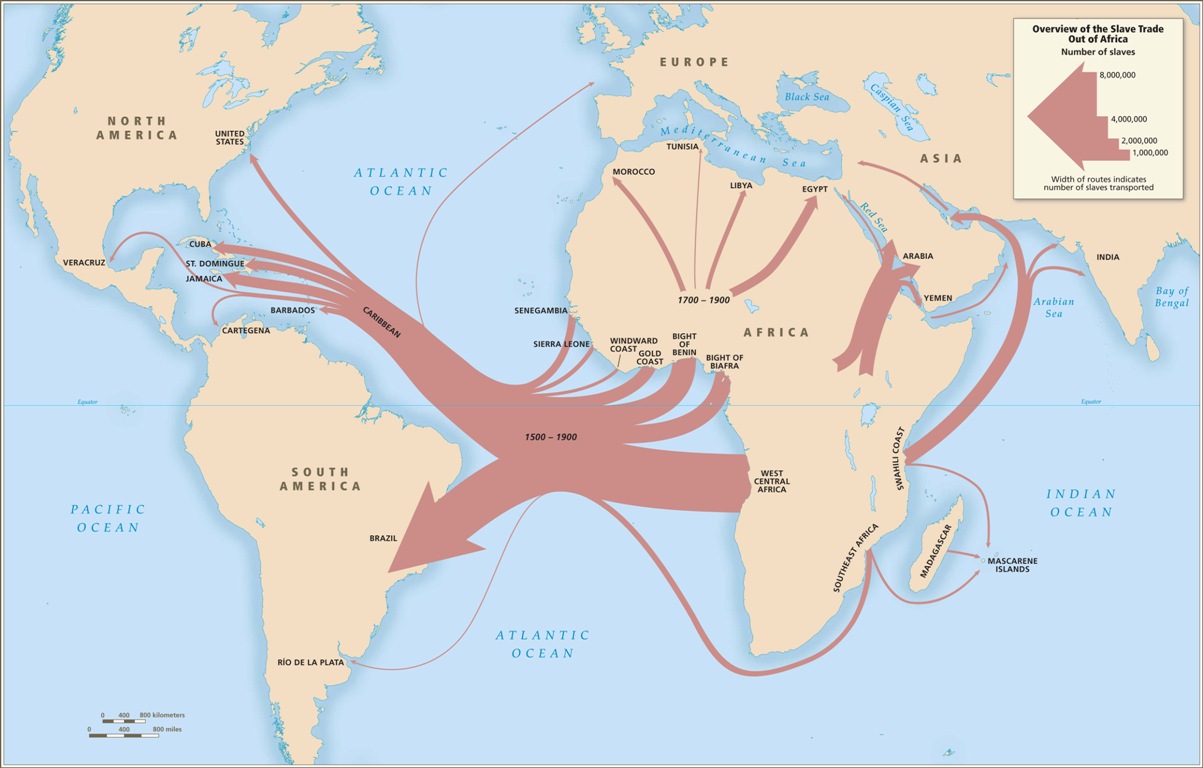
Map: Overview of the Slave Trade Out of Africa, SlaveVoyages, https://api.slavevoyages.org/static/uploads/01.jpg
Transatlantic Slave Trade
“The transatlantic slave trade was an oceanic trade in African men, women, and children which lasted from the mid-sixteenth century until the 1860s. European traders loaded African captives at dozens of points on the African coast, from Senegambia to Angola and round the Cape to Mozambique. The great majority of captives were collected from West and Central Africa and from Angola. The trade was initiated by the Portuguese and Spanish especially after the settlement of sugar plantations in the Americas. European planters spread sugar, cultivated by enslaved Africans on plantations in Brazil, and later Barbados, throughout the Caribbean. In time, planters sought to grow other profitable crops, such as tobacco, rice, coffee, cocoa, and cotton, with European indentured laborers as well as African and Indian slave laborers. Nearly 70 percent of all African laborers in the Americas worked on plantations that grew sugar cane and produced sugar, rum, molasses, and other byproducts for export to Europe, North America, and elsewhere in the Atlantic world. Before the first Africans arrived in British North America in 1619, more than half a million African captives had already been transported and enslaved in Brazil. By the end of the nineteenth century, that number had risen to more than 4 million. Northern European powers soon followed Portugal and Spain into the transatlantic slave trade. The majority of African captives were carried by the Portuguese, Brazilians, the British, French, and Dutch. British slave traders alone transported 3.5 million Africans to the Americas.”[1]
SlaveVoyages Database
"The Trans-Atlantic and Intra-American slave trade databases are the culmination of several decades of independent and collaborative research by scholars drawing upon data in libraries and archives around the Atlantic world. The new SlaveVoyages website itself is the product of three years of development by a multi-disciplinary team of historians, librarians, curriculum specialists, cartographers, computer programmers, and web designers, in consultation with scholars of the slave trade from universities in Europe, Africa, South America, and North America. The National Endowment for the Humanities was the principal sponsor of this work carried out originally at Emory Center for Digital Scholarship, the University of California at Irvine, and the University of California at Santa Cruz. The Hutchins Center of Harvard University has also provided support. The website is currently hosted at Rice University."[2]
Domestic Slave Trade in the United States
“The second forced migration was known as the domestic, or internal, slave trade: “In the seven decades between the ratification of the Constitution [in 1787] and the Civil War [1861],” the historian Walter Johnson tells us in his book Soul by Soul: Life Inside the Antebellum Slave Market, “approximately one million enslaved people were relocated from the upper South to the lower South … two thirds of these through … the domestic slave trade.” In other words, two and a half times more African Americans were directly affected by the second Middle Passage than the first one.”[3]
Slavery and the Law in the United States
“The use of enslaved laborers was affirmed — and its continual growth was promoted — through the creation of a Virginia law in 1662 that decreed that the status of the child followed the status of the mother, which meant that enslaved women gave birth to generations of children of African descent who were now seen as commodities. This natural increase allowed the colonies — and then the United States — to become a slave nation. The law also secured wealth for European colonists and generations of their descendants, even as free black people could be legally prohibited from bequeathing their wealth to their children. At the same time, racial and class hierarchies were being coded into law: In the 1640s, John Punch, a black servant, escaped bondage with two white indentured servants. Once caught, his companions received additional years of servitude, while Punch was determined enslaved for life. In the wake of Bacon’s Rebellion, in which free and enslaved black people aligned themselves with poor white people and yeoman white farmers against the government, more stringent laws were enacted that defined status based on race and class. Black people in America were being enslaved for life, while the protections of whiteness were formalized.”[4]
Citations
[1] “Transatlantic Slave Trade,” Slavery and Remembrance: A Guide to Sites, Museums, and Memory, accessed November 18, 2019, http://slaveryandremembrance.org/articles/article/?id=A0002. See also David Northrup, "The Atlantic Slave Trade," Atlantic History, Oxford Bibliographies, 2010, and Ty M. Reese, "Slavery in Africa," Atlantic History, Oxford Bibliographies, 2019.
[2] SlaveVoyages, accessed February 18, 2026, https://www.slavevoyages.org/.
[3] Henry Louis Gates Jr., “What Was the Second Middle Passage?” The African Americans: Many Rivers to Cross, PBS, accessed November 18, 2019, https://www.pbs.org/wnet/african-americans-many-rivers-to-cross/history/what-was-the-2nd-middle-passage/. See also Michael Tadman, "Domestic Slave Trades in the Americas," Atlantic History, Oxford Bibliographies, 2014.
[4] Mary Elliot, “Four Hundred Years After Enslaved Africans Were First Brought to Virginia, Most Americans Still Don’t Know the Full Story of Slavery,” New York Times, August 19, 2019, accessed November 18, 2019, https://www.nytimes.com/interactive/2019/08/19/magazine/history-slavery-smithsonian.html. See also Paul Finkleman, “Slavery in the United States: Persons or Property?” The Legal Understanding of Slavery: From the Historical to the Contemporary, edited by Jean Allain (Oxford University Press, 2012), pages 105-134, accessed November 18, 2019, https://scholarship.law.duke.edu/cgi/viewcontent.cgi?article=5386&context=faculty_scholarship).
Updated January 26, 2026.